
Consumer and retail in MENA is a category we have wanted to back since 2023. Over that period, we examined a wide range of direct-to-consumer and omnichannel businesses across the GCC but never followed through with an investment, because the category was still early, harder to underwrite than software, and unforgiving of founders who can’t build a real brand.
Conviction, Earned Over Time
We met Shubham Poddar early on in his journey, when he was raising Amaani’s pre seed round, and stayed close to the business from there. What stood out over time was Shubham’s ability to build and adapt quickly, while the business itself began showing clear signs of pull from both customers and retailers. That combination gave us the conviction to partner with him and in September 2026, we led their $5M Series A, alongside Peak XV and Homegrown Ventures.
From Backing Beauty Brands to Building One
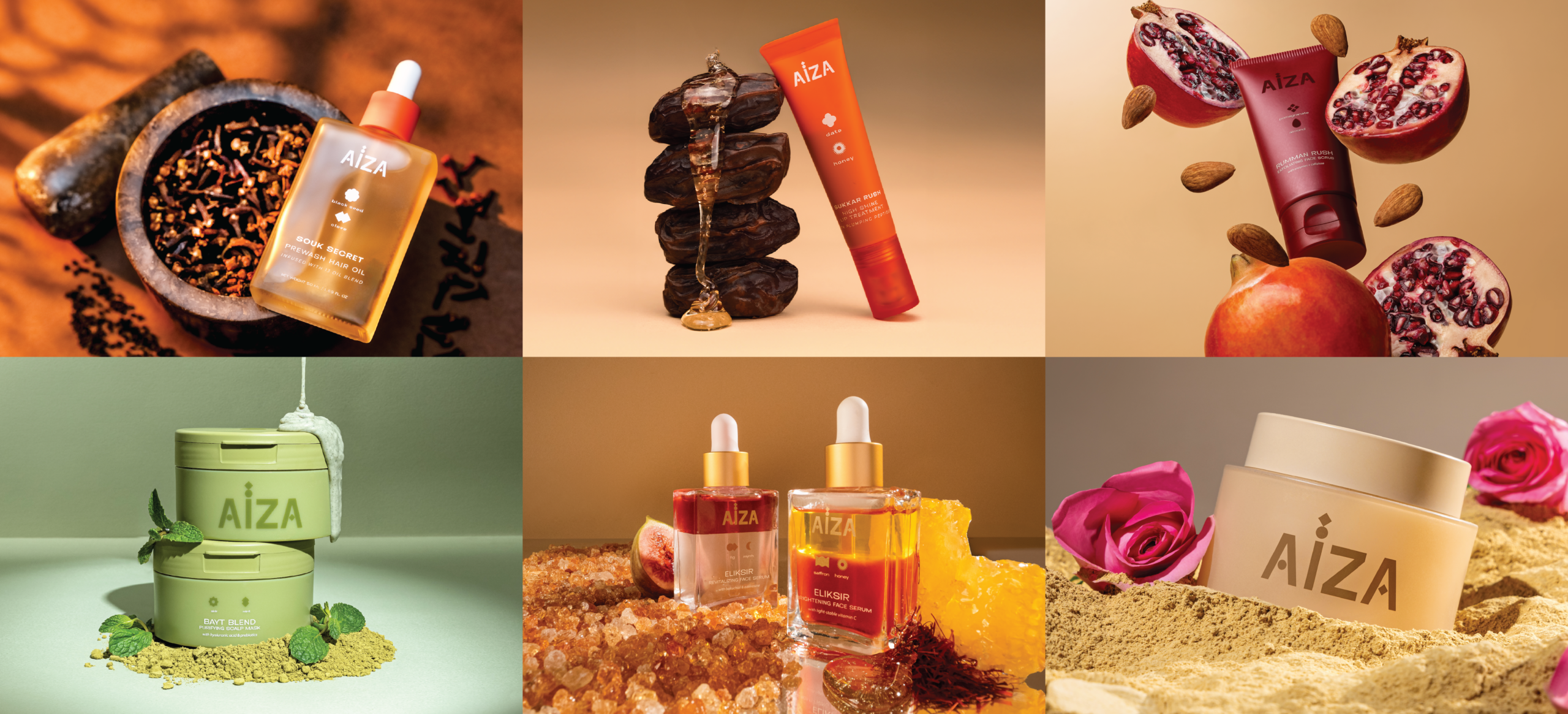
Amaani’s first brand, AÏZA, is a Dubai-based masstige beauty brand, combining prestige positioning with a mass market price point and built specifically for the GCC consumer. Its “Past Forward” philosophy brings together regional ingredients, including dates, black seed and bakhoor, with clinically proven actives, with products developed in specialist laboratories across Korea, Japan and Italy.
That same thinking shaped how AÏZA entered the market. Rather than asking consumers to immediately replace products already embedded in their daily routines, the brand started with categories such as lip care, brow and lash serums, and hair mists that could sit naturally alongside them. The idea was to earn a place in the consumer’s routine first, build trust, and expand from there.
The opportunity to build a brand this way was what initially drew Shubham to the region. After spending time in Dubai, he saw a large and growing beauty market, but relatively few homegrown brands being built for scale. His perspective was shaped by his time at Peak XV, formerly Sequoia India, where he worked on D2C beauty investments including Mamaearth, now publicly listed, and Minimalist, which was acquired by Hindustan Unilever.
Moving from investing in beauty brands to building one himself gave Shubham an unusual starting point. He paired his perspective on category dynamics and capital efficiency with a team bringing deep operating experience from L’Oréal, Huda Beauty, Elizabeth Arden and Careem across brand, formulation, growth and operations. It was this combination of an investor’s perspective and experienced category operators that caught our attention early on.
Room for a Brand of Its Own
Stepping back from the company, the market it serves spends on beauty like few others. The GCC beauty and personal care market is approximately $12B and growing at 12% a year, and beauty’s share of total retail spend in KSA and the UAE runs at 10% to 11%, roughly 3x that of most major markets, according to RedSeer. Global retailers have followed the demand; Sephora’s Dubai Mall location is among its highest-grossing stores worldwide, and Ulta Beauty made the GCC one of its first markets outside the US. Yet most of that spend still goes to brands built elsewhere. At the same time, Arab beauty is moving from a regional niche to a global category, with ingredients long present in the Gulf, such as oud, appearing in formulations reaching global audiences from brands such as Amouage and Kayali, much like K-beauty’s earlier rise.
The Market Opened at the Right Moment
The gap sits between consumer demand and the brands built to serve it. Regional consumers are among the world’s most engaged beauty buyers, yet much of what they buy was designed for other markets. Building a credible alternative takes time: differentiated formulations, repeat customer behaviour and physical retail distribution are all built over years, not months. That difficulty helps explain why relatively few scaled regional brands have emerged, but it is also what can make those that do difficult to replicate.
What makes the opportunity particularly interesting today is that the GCC has developed the infrastructure to support these brands at scale. The region has moved from mall first to mobile first without leaving physical retail behind. Footfall across major retail centres in the UAE and Saudi Arabia has recovered, while online penetration has continued to grow. Rather than one channel replacing the other, consumers increasingly move between both, creating a market where brand and experience matter as much as distribution.
The infrastructure around that experience has matured alongside it. Same day and next day delivery have become standard, card penetration and buy now pay later have reduced checkout friction, and returns have become increasingly normalized. Many markets have consumer demand without the infrastructure to serve it, or infrastructure without sufficient demand. The GCC increasingly has both.
And the consumer is changing with it. The middle income cohort that drives masstige demand is growing, beauty is taking a larger share online, and regional retailers that were once difficult for emerging brands to access are increasingly opening their doors. Just as importantly, consumers have become more willing to discover, adopt and champion brands built in the region. Together, these shifts create the conditions for local brands to be built in the GCC with global ambitions from day one.
Recognition Beyond the Region
Since its commercial launch in 2025, AÏZA has grown across the UAE, Saudi Arabia, and the wider GCC, with growth coming from both new and repeat customers, and a meaningful share of repeat customers moving beyond their first product into others in the range. Within months of launch, Ulta Beauty selected AÏZA for its first UAE stores, where the brand has been among the top performers since opening. The brand is live on Ounass, the region’s luxury e-commerce destination, giving it a presence across both mass and premium retail. AÏZA also became the first Middle Eastern brand named to BeautyMatter’s NEXT50, an annual list of the world’s most promising emerging beauty companies.
A Brand That Earns Its Place
Our conviction rests on the combination of a structurally attractive market and a company built deliberately for it. The GCC’s beauty spend is large and durable, while AÏZA’s early economics give the company room to invest in building the brand over a long horizon. The category has also produced compelling outcomes with relatively little capital: Sol de Janeiro was acquired by L’Occitane for $450M after raising less than $15M, while Tatcha was acquired by Unilever for roughly $500M after raising around $21M.
We have watched Shubham and the team build Amaani from its early days, and are excited to now partner with them for the next chapter. There is a long way to go, but the ambition is clear: to build a defining beauty company from this region for consumers here and around the world.